

How Does Finasteride Work For Hair Loss?

Medically reviewed by
Dr. Simon Khela (Mbchb Mrcgp)
Reading Time: 7 min. Published: 24/01/2025 Last Updated: 20/04/2026
how does finasteride work

Finasteride is the world’s most recommended male hair growth drug [1]. Almost 70% of hair transplant surgeons always or often recommend finasteride to their patients to minimise ongoing hair loss and prevent the need for future procedures.

But it’s not just useful for hair transplant surgery patients. In its 1 mg tablet form, finasteride is one of the most effective remedies and preventative drugs for male pattern baldness currently available.

So how exactly does finasteride work to tackle hair loss in men? Here, you’ll discover:

  • How finasteride works.
  • How effective finasteride is for treating male pattern baldness.
  • The side effects of finasteride for hair loss.
  • How to decide if finasteride is the right treatment for you.

What is finasteride and how does it work?

Finasteride belongs to a group of drugs known as 5-alpha-reductase inhibitors. 5-alpha-reductase is a naturally occurring enzyme that triggers the conversion of testosterone to dihydrotestosterone, or DHT.

DHT is a male sex hormone that’s responsible for the development of male pattern baldness, as well as many other processes in the body (particularly related to male development, such as body and facial hair growth) [2]. It binds to hormone receptors in your hair follicles. This makes the follicles shrink, slowing and eventually stopping hair production altogether.
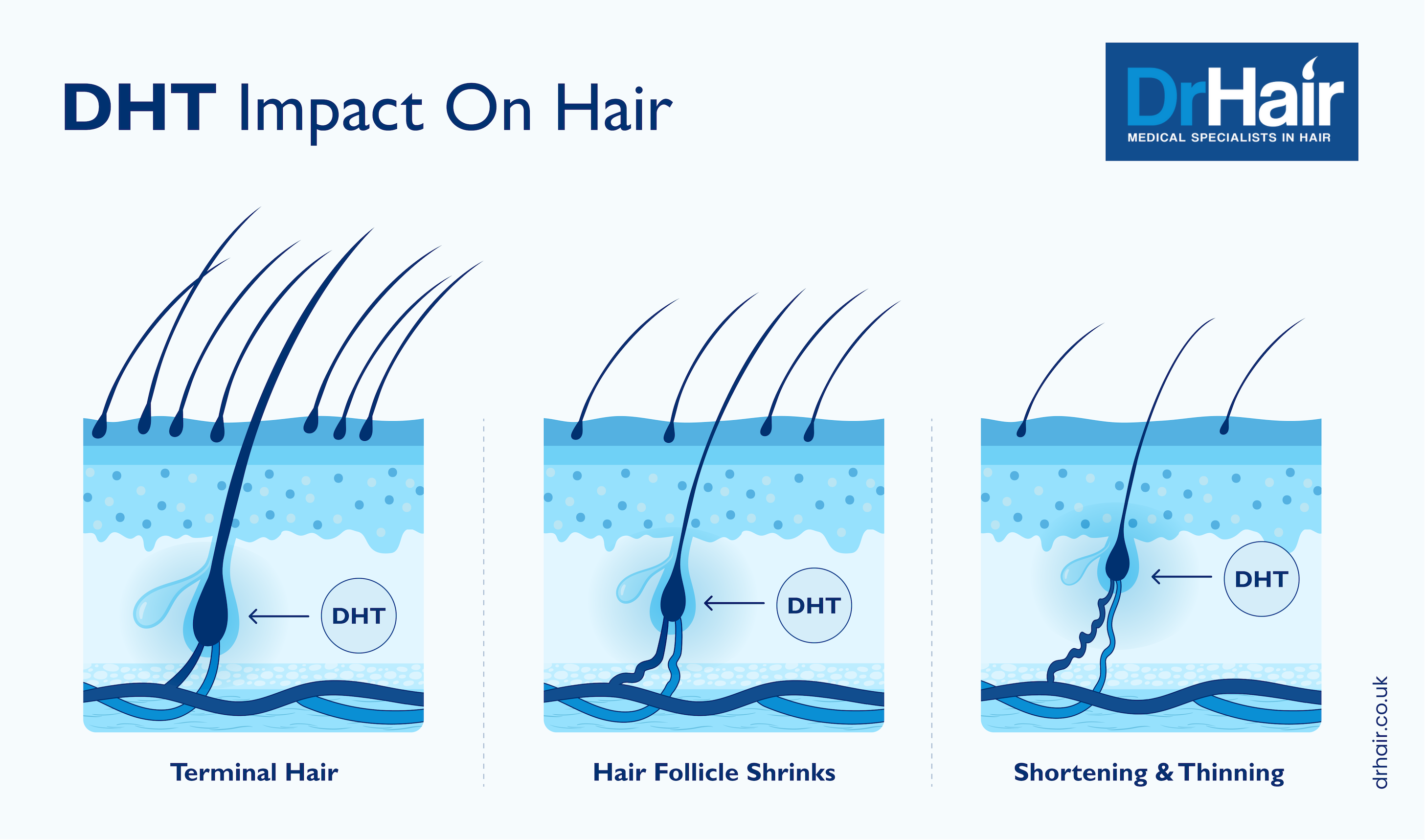
DHT impact on hair

By inhibiting the activity of the 5-alpha-reductase enzyme, finasteride can lower the amount of DHT your body produces. That means there’s less DHT to bind to your follicles, and therefore a lower impact on your hair growth.
How effective is finasteride for hair loss?

Finasteride is very effective at slowing hair loss. Research suggests it can lower the amount of DHT your body produces by up to 70% [3].

While results differ between studies, it’s universally accepted that finasteride has strong success rates when it comes to slowing the progression of male pattern baldness, even in the long term [4-6]. In one study, researchers observed no further hair loss in 83% of men with crown hair loss after 2 years of finasteride use, and 70% of men with a receding hairline after 1 year [6].

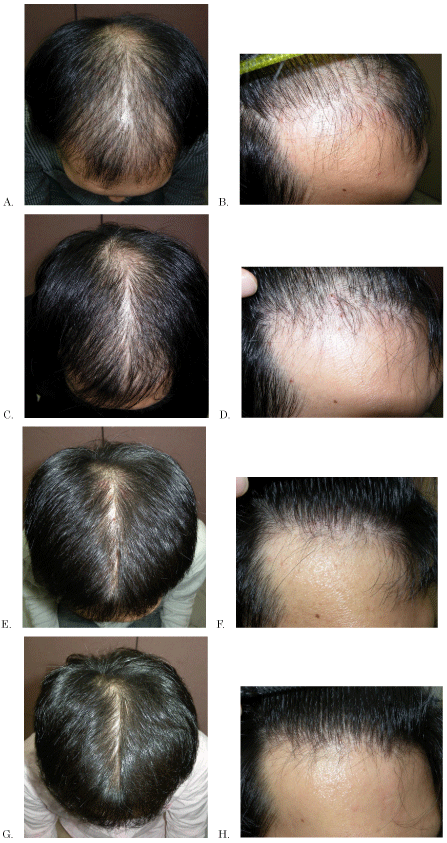
Progression of hair loss over 5 years of finasteride use
Progression of hair loss over 5 years of daily 1 mg finasteride use: A, B: baseline hair loss. C, D: 6 months of finasteride use. E, F: 2 years of finasteride use. G, H: 5 years of finasteride use. Source & image credit: [4].

In many cases, finasteride can also stimulate hair regrowth. According to one study, the chances of regrowth from finasteride treatment are 61% on the crown (after 2 years), and 37% on the hairline (after 1 year) [6].

Does finasteride always work?

While finasteride is very effective in the early stages of hair loss, its impact tends to diminish if your hair loss is extensive or very established. That’s because your follicles can reach a point of no return. Once they shrink beyond a certain point, finasteride won’t be able to reactivate them to produce new hair. So using finasteride earlier in your hair loss journey tends to yield better results.

That said, research has shown that even if finasteride doesn’t stop your hair loss completely, it can slow the rate of loss [6]. That means you may be able to delay balding and/or the need for more invasive treatments.

What are the side effects of finasteride?

The most common side effect of finasteride is temporary hair shedding. This is a normal and expected side effect that happens as hairs shed to make way for new growth. In most cases, this starts within a few weeks of treatment and lasts up to a month.

Sexual side effects, which tend to cause the most concern among potential users, occur in up to 3.8% of users, according to a review of 6 studies [7]. So the prevalence is relatively low. Sexual side effects of finasteride include:

  • Loss of libido
  • Erectile dysfunction
  • Ejaculatory dysfunction

There may also be a link between finasteride use and fertility, so it’s recommended that you stop taking finasteride for at least 3 months before trying to conceive. Women (particularly those who are pregnant or trying to conceive) should avoid taking finasteride altogether.

Some finasteride users also report mental health changes, such as depressive symptoms and low mood [8].

Learn how to reduce the side effects of finasteride without losing your hair.

Is finasteride the right treatment for you?

Man examining his hairline

Finasteride is a safe, well-tolerated treatment that can stop hair loss and may even promote regrowth in men with male pattern baldness, but not everyone is eligible to take it. Finasteride generally isn’t suitable for women, those with other types of hair loss, as well as those with certain pre-existing health conditions.

Minoxidil can help improve symptoms of hair loss both by itself and alongside finasteride. Using finasteride and minoxidil at the same time can create better results than either treatment by itself [9]. Take a look at the potential finasteride and minoxidil results eligible patients could see.

Ultimately, you need a clinical assessment to determine which hair loss treatments are suitable for you. At DrHair, we offer a free online assessment so you can see which solutions our pharmacists could prescribe to you based on your specific circumstances.

FAQs

Learn more about how finasteride works in these FAQs.

Most finasteride users see slowing hair loss within 3-6 months, and noticeable regrowth from 6 months onwards. You’ll need to take finasteride 1 mg consistently every day for fastest results.

Learn more about how long finasteride takes to work.

In most cases, no. Finasteride 1 mg is the optimum dosage for treating male pattern baldness [3]. There’s no evidence that taking a higher dose will result in higher serum DHT reduction or a reduction in hair loss. But it may put you at greater risk of adverse side effects [10].

Finasteride 5 mg is more often used to treat benign prostate enlargement. Unlike finasteride 1 mg, finasteride 5 mg isn’t licensed as a hair loss treatment. So it should only be considered in exceptional cases and with support from a doctor or qualified trichologist.

Finasteride reduces the amount of DHT your body produces. As well as affecting your rate of hair loss, this can impact you in other ways, such as:

  • Reducing body and facial hair growth
  • Affecting your mental health
  • Sexual side effects like erectile dysfunction

Adverse effects are rare. But if you’re concerned about the side effects of finasteride, speak to your doctor or book a consultation with our team.

Missing the odd dose of finasteride won’t have a significant impact on your hair growth. However, if you regularly start to skip or miss doses, your results may be compromised. So it’s best to take finasteride every day (ideally, around the same time).

No, there’s no difference in effectiveness between Propecia vs generic finasteride 1 mg products. Propecia tends to be more expensive but the active ingredient is the same.

Medically reviewed by
Dr. Simon Khela (Mbchb Mrcgp)

Results in 3-6 months

Flexible subscriptions, free delivery

UK licensed experts & aftercare team

Read also

SEE A SPECIALIST

Book an online consultation
with a specialist.

Clinical review within 2-24 hrs

Treatment Plan
Empty CartYour cart is emptyAdd your favourite items to your cart.
Calculate Shipping
Apply Coupon