

Topical finasteride is a hair loss treatment applied directly to the scalp that has gained attention as an alternative to the more widely used oral tablet form. While it works through the same active ingredient, its localised application means it targets the scalp directly rather than affecting the whole body. That means it reduces the chance of experiencing systemic side effects like low mood and sexual dysfunction.
Despite its potential, topical finasteride remains far less commonly recommended than oral finasteride. A survey of hair restoration surgeons found that only 17% always or often recommend it, compared to 69% who say the same of the oral version [1X]. That said, growing evidence suggests the two forms may be broadly comparable in terms of effectiveness for male pattern baldness.
In this article, we cover everything you need to know about topical finasteride, including how it works, what results to expect, and how it compares to oral finasteride as a treatment option.
What is topical finasteride?
Topical finasteride is an off-label prescription liquid solution that is applied directly to the scalp to slow hair loss and encourage regrowth in men with male pattern baldness. Rather than being taken orally, it is designed to work locally on the affected areas of the scalp, which may reduce the risk of systemic side effects associated with the tablet form. It is typically formulated at concentrations of 0.1% to 0.25%, though this can vary depending on the prescriber and the compounding pharmacy used.
It is important to be aware that topical finasteride is only intended for scalp hair loss related to androgenetic alopecia. It is not effective for other types of hair loss, nor will it improve beard or body hair growth.
Does topical finasteride work for hair loss?
Yes, a growing body of research supports the effectiveness of topical finasteride in treating androgenetic alopecia, the clinical term for male pattern baldness in men and female pattern hair loss in women [2-5].
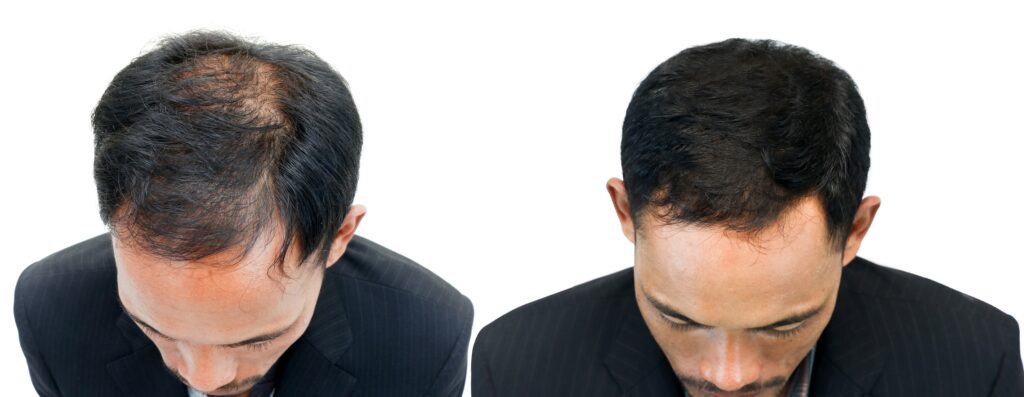
A systematic review examining the evidence for topical finasteride found that studies consistently reported the following outcomes [6]:
- A significant reduction in the rate of hair loss
- An increase in total hair count
- An increase in terminal hairs; the thicker, more established hairs that tend to be permanent
- Positive overall hair growth assessments
Who is topical finasteride suitable for?
Topical finasteride is suitable for treating androgenetic alopecia in men. It is not effective for other forms of hair loss, including alopecia areata or telogen effluvium, as these conditions are not driven by elevated dihydrotestosterone levels.
Some researchers have suggested that topical finasteride may also be a viable option for women experiencing female pattern hair loss [2]. This is a potentially significant development, given that oral finasteride is generally not recommended for women due to the risk of complications and side effects. Most pharmacies still take a very cautious approach to prescribing topical finasteride to female patients.
It is important to note, however, that topical finasteride is not currently licensed for use in the UK. Any use at present would be off-label, and you should always follow the guidance of a qualified doctor or healthcare professional before starting treatment.
If you are concerned about hair loss, taking our brief assessment is a good first step towards understanding your options.
Is topical finasteride licensed in the UK?
Topical finasteride is not currently licensed for use in the UK by the Medicines and Healthcare products Regulatory Agency (MHRA), nor has it received approval from any other national medical regulatory body.
While early clinical studies have shown promising results, there is not yet sufficient evidence to support widespread licensed use. Regulatory bodies such as the MHRA require medicines to undergo rigorous testing across large patient populations before approval can be granted.
That said, unlicensed does not mean unavailable. A qualified hair loss specialist or GP can prescribe topical finasteride off-label in the UK if they consider it a clinically appropriate option for your circumstances.
Topical vs oral finasteride
When weighing up topical and oral finasteride as treatment options, there are a few key differences worth understanding:
Topical Finasteride | Oral Finasteride | |
Effectiveness | Broadly similar results to oral finasteride [4-5] | Well-established, licensed treatment for male pattern baldness; shown to halt hair loss in up to 83% of men after two years [7] |
Side effects | Fewer systemic and sexual side effects than oral finasteride [5,6] | More likely to cause systemic and sexual side effects |
Eligibility | Generally not recommended for women or men trying to conceive [2] | Generally not recommended for women or men trying to conceive |
Licensing | Not yet licensed by the MHRA; prescribed off-label only | Licensed for male pattern baldness in the UK |
Is topical finasteride better than oral?
Topical finasteride is non-inferior to oral for hair regrowth, but with a meaningfully better side effect profile. A phase III trial found that adverse events in the topical finasteride group were similar to placebo and lower than the oral group, with only 2.8% of topical users withdrawing due to side effects compared to 7.1% on oral finasteride. Plasma concentrations of finasteride are around 100-fold lower with topical application versus 1 mg oral finasteride [6].
How long does topical finasteride take to work?
Most men begin to notice a visible reduction in hair loss after around six months of consistent use [4]. This is somewhat longer than the typical timeline for oral finasteride, which can produce noticeable improvements within four months [4].
As with any hair loss treatment, individual results will vary, and it is important to use topical finasteride consistently and as directed by your prescriber to give it the best chance of working.
Is topical finasteride safe?
For most men, topical finasteride is considered safe for daily use and tends to produce fewer significant adverse effects than the oral tablet form. However, as with any medication, there are some side effects to be aware of [8]:
- Itchy or burning scalp
- Skin irritation
- Contact dermatitis
- Erythema (red patches)
These side effects are generally localised to the scalp and do not typically affect other areas of the body.
Topical finasteride is not recommended for women who are pregnant or breastfeeding. If you have any underlying health conditions, it is advisable to speak to your GP or a qualified healthcare professional before starting treatment. You can also book a consultation with us, at DrHair.
Can you use topical finasteride with minoxidil?
Yes, you can use topical finasteride with minoxidil. Research suggests that combining topical finasteride with minoxidil may produce better results than using either treatment on its own [5,9]. Minoxidil is a licensed topical hair loss treatment widely used across a range of hair loss conditions and is available without prescription in the UK.
There is also evidence to suggest that a combined topical finasteride and minoxidil solution can help maintain hair density after completing a course of oral finasteride [9]. So if you’re struggling with the side effects of oral finasteride, this may be a viable alternative.
How to apply topical finasteride
Topical finasteride is typically dispensed via a spray or dropper bottle, making it straightforward to apply at home. Follow these steps for correct application:
- Prepare your scalp — ensure the area is clean and dry before applying the solution.
- Apply the prescribed amount — use the spray nozzle or dropper to apply the dose recommended by your prescriber, typically one drop or spray per application.
- Distribute evenly — use your fingertips to gently spread the solution across the affected areas. Do not rub it in vigorously.
- Repeat as directed — apply once or twice daily in line with your prescription.
The same steps apply if you are using a combined topical finasteride and minoxidil spray. If you are unsure about the correct application method, speak to your prescriber or pharmacist for guidance.
See if you’re suitable for topical finasteride with DrHair
If you are experiencing pattern hair loss and want to explore whether topical finasteride could be the right treatment for you, DrHair can help. Our online assessment is designed to identify which treatments you may be eligible for, taking into account your individual circumstances.
FAQs
Making topical finasteride at home is not a safe or reliable approach, despite instructions circulating online. These guides typically involve crushing oral finasteride tablets and dissolving them in a liquid, but there are several reasons why this is inadvisable:
- Finasteride is a prescription-only medicine in the UK and should only ever be used under the guidance of a qualified doctor or pharmacist
- The safety profile of any homemade preparation is unknown, meaning it could actively hinder hair growth rather than support it
- Oral tablets contain excipients that are not approved for topical application on the skin
- The active ingredient concentration in an oral tablet is not equivalent to that of a properly formulated topical solution
- Skin irritation and other unpredictable adverse reactions are a real possibility
- Topical formulations contain excipients that enhance the absorption of finasteride through the skin. Homemade preparations will not contain these excipients and therefore are unlikely to be as effective as topical formulations supplied by pharmacies
If topical finasteride is something you want to explore, speak to a healthcare professional who can assess your suitability and prescribe an appropriately formulated product.
Yes, topical finasteride is a prescription-only medicine in the UK. It cannot be purchased over the counter and must be prescribed by a qualified doctor or hair loss specialist.
No, 25 is not too late to start finasteride, but its effectiveness generally depends on the amount of hair you’ve lost rather than your age. In fact, starting treatment earlier in the hair loss process tends to produce better outcomes, as finasteride is more effective at slowing and halting hair loss than it is at recovering hair that has already been lost for a significant period of time.
Research suggests topical and oral finasteride produce broadly comparable results for male pattern baldness, with the topical form carrying a lower risk of systemic side effects [6].