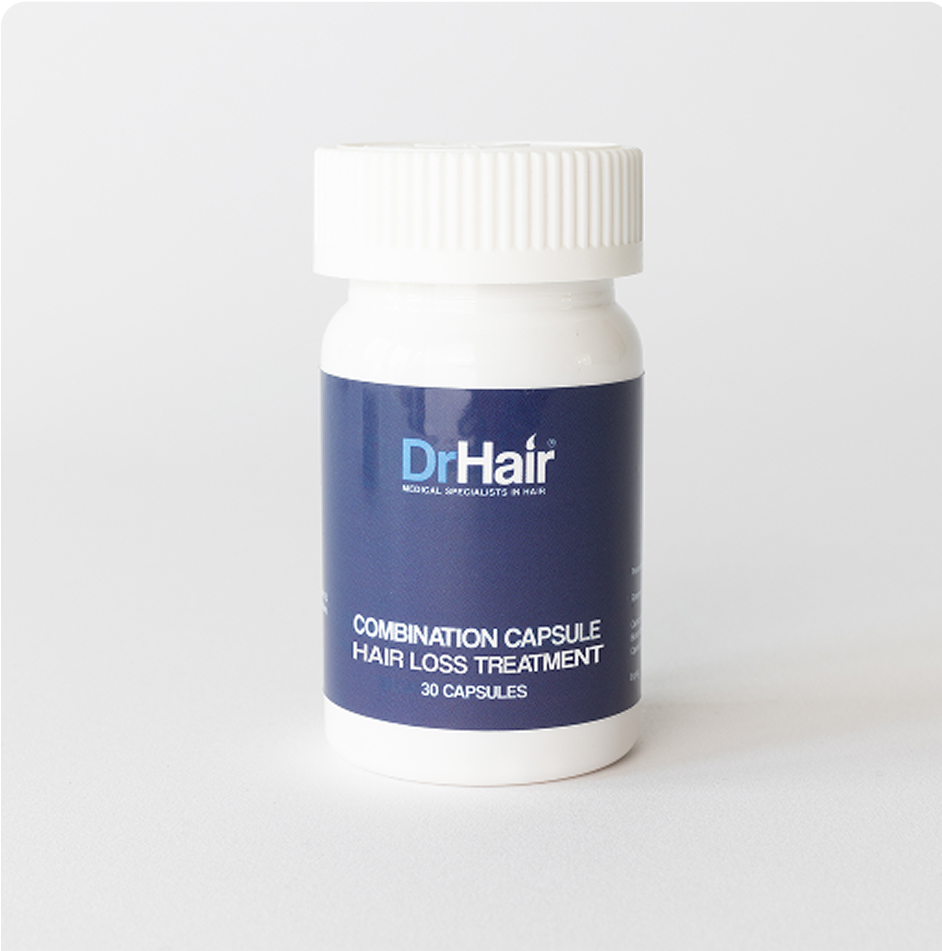


Minoxidil 5% is among the most widely used topical hair loss treatments available. Clinical evidence supports its effectiveness across a range of conditions, including male pattern baldness, female pattern hair loss, and alopecia areata [1-3].
If you are considering minoxidil 5% as a treatment option, this guide covers everything you need to know, including how effective it is, what side effects to be aware of, and whether it is the right choice for your circumstances.
What is minoxidil 5%?
Minoxidil 5% is a topical hair loss solution containing 5 g of the active ingredient per 100 ml of liquid. This places it above the 2% formulation and below the 10% version, both of which are also used in hair loss treatment (however, the 10% option is much less common and not currently licensed).
Minoxidil 5% works as a vasodilator, dilating the blood vessels beneath the scalp to increase blood flow to hair follicles that have begun to shrink. This improved circulation delivers more oxygen and nutrients to the follicle, creating better conditions for regrowth. Minoxidil can also activate potassium channels in hair follicle stem cells and peripheral artery cells, which may further support cell proliferation and hair production.
Does minoxidil 5% work for hair loss?
Clinical evidence supports minoxidil 5% as an effective option for both slowing hair loss and encouraging regrowth, with a relatively mild side effect profile compared to other treatments. Research indicates that it is effective or very effective in halting hair loss in 63.7% of users [4].
One study found that minoxidil 5% reduced the size of balding areas in 62% of patients, while a further 35.1% saw their hair loss stabilise with no further progression. Only 2.9% of users reported no improvement whatsoever [4].
Minoxidil 5% results: what to expect and when
Most people begin to notice a reduction in hair shedding within the first few weeks of starting minoxidil 5%, though visible regrowth typically takes longer. Here is a general guide to what to expect at each stage [4]:
Timeframe | What to expect |
Weeks 1 to 4 | Some users experience an initial shedding phase as minoxidil pushes resting follicles into the growth phase. This is normal and temporary. |
3 to 6 months | The first signs of visible improvement begin to appear, including reduced shedding and early regrowth in treated areas. |
6 to 12 months | More significant improvements in hair density and coverage become apparent. This is typically when the most noticeable changes occur. |
12 to 24 months | Results continue to build, with peak density usually reached around the one to two year mark. |
It is important to note that results vary between individuals and depend on factors such as the extent of hair loss, how consistently the treatment is applied, and how early it was started [1].
Minoxidil 5% side effects
Minoxidil 5% can cause side effects, though these are generally milder than those associated with higher concentrations such as minoxidil 10%, or with other hair loss treatments including finasteride and dutasteride.
The most commonly reported side effects include:
- Skin irritation
- Itchiness
- Allergic contact dermatitis
- Hypertrichosis (excessive hair growth, occasionally beyond the area of application)
- Temporary hair shedding in the early stages of treatment
- Changes in hair colour
Side effects tend to be more pronounced at higher concentrations, and the 5% formulation carries a greater risk than the 2% version in this regard. Hypertrichosis is a particular concern for women, as unwanted facial or body hair growth can be difficult to manage. For this reason, the 2% formulation is often recommended for female patients as a starting point [5].
Does minoxidil 5% influence your hormones?
Unlike 5-alpha reductase inhibitors such as finasteride and dutasteride, minoxidil 5% does not act on hormone levels. It has no impact on testosterone or DHT production.
Oral minoxidil is generally considered more effective than the 5% topical solution [5], but because it works systemically rather than locally, it carries a higher risk of side effects elsewhere in the body. This is why oral minoxidil is not typically used as a first-line treatment, despite its effectiveness.
Can women use minoxidil 5%?
Minoxidil 5% is considered a safe and effective treatment for female hair loss [1, 5], though women should be aware of the risk of hypertrichosis at higher concentrations [6]. This refers to unwanted hair growth on the face, chest, back, or other areas beyond the scalp. Women who are concerned about this side effect may wish to start with the 2% formulation before considering a higher strength.

How to apply minoxidil 5%
For best results, most people are advised to apply 1 ml of minoxidil 5% to the scalp twice daily, once in the morning and once in the evening. This is typically equivalent to one pump, spray, or pipette of solution depending on the product you are using.
Follow these steps for correct application:
- Prepare the area. Make sure your scalp is clean and dry before applying. Applying to a wet or damp scalp can dilute the solution and reduce its effectiveness.
- Apply the solution. Use the pump, spray, or pipette to dispense 1 ml directly onto the thinning or balding areas of the scalp. Focus on the hairline, crown, or wherever hair loss is most visible.
- Spread evenly. Use your fingertips to gently distribute the solution across the affected area. Do not rub it in vigorously or spread it beyond the target area.
- Allow to dry. Leave the solution to absorb fully before styling your hair or going to bed. This typically takes around four hours.
- Wash your hands. Minoxidil can promote unwanted hair growth if it comes into contact with other areas of the body, so always wash your hands thoroughly after each application.
Consistency is key. Applying minoxidil at the same time each day helps maintain steady levels of the treatment on the scalp and gives it the best chance of working effectively over time.
See if minoxidil 5% is right for you with DrHair
Minoxidil 5% is a well-established first-line treatment for mild to moderate hair loss and tends to deliver the best results when started early, before significant follicle miniaturisation has occurred.
For men with male pattern baldness, combining minoxidil 5% with finasteride has been shown to enhance the effectiveness of both treatments [7]. Finasteride is a prescription-only medicine, however, and is not appropriate for everyone.
If you are unsure whether minoxidil 5% is the right option for your circumstances, taking our assessment is a straightforward first step towards understanding which treatments you may be eligible for.
FAQs
Minoxidil 5% is one of the most clinically supported hair loss treatments available. Research shows it is effective or very effective in halting hair loss in over 63% of users, with nearly two thirds seeing a reduction in the size of balding areas. Results are best when treatment is started early and maintained consistently.
Yes, and daily use is recommended for best results. Most users are advised to apply 1 ml of minoxidil 5% to the affected areas of the scalp twice a day. Skipping applications or using it less frequently than directed can reduce its effectiveness over time.
Minoxidil is not suitable for everyone. It is generally not recommended for women who are pregnant or breastfeeding, or for those with certain cardiovascular conditions. It is also not effective for all types of hair loss, as it does not address the hormonal causes of androgenetic alopecia in the way that finasteride does. If you are unsure whether it is appropriate for you, speak to a healthcare professional before starting treatment.
After two years of consistent use, most people will have seen the full benefit minoxidil can offer. Results typically peak around the one to two year mark, after which the focus shifts to maintaining them through continued daily use. Stopping treatment at any point will likely cause hair loss to resume.
There is no clinical evidence to support this claim. Minoxidil has been in widespread use for decades and no credible research has linked it to premature ageing. If you notice any changes to your skin while using minoxidil, speak to your doctor.
If you stop using minoxidil, any hair you have regrown or retained as a result of treatment will gradually be lost again. This typically begins within a few months of discontinuing use, as the follicles return to their previous state without the stimulation minoxidil provides.
5% minoxidil is effective for female pattern hair loss but carries a slightly higher risk of side effects than the 2% formulation, particularly hypertrichosis. Women who are pregnant or breastfeeding should avoid it. If you are unsure which strength is right for you, speak to a healthcare professional before starting treatment.